

In this guide
- Quick Picks
- What is the actual difference between an Instant Pot and a Ninja Foodi?
- How much counter space does each one really take?
- Which one actually air-fries better?
- Which one gets to pressure faster?
- Which one is easier to clean?
- Which is quieter when releasing steam?
- Which is better for a family of four?
- Can you bake bread in either one?
- Is it safe to buy a Ninja Foodi after the 2025 recall?
- Full comparison: Instant Pot vs Ninja Foodi
- Buy neither, if…
- How we picked
- Frequently asked questions
- The bottom line
- Related guides
Part of our Kitchen buying guides — which appliances earn their counter space.
As an Amazon Associate I earn from qualifying purchases.
Last updated: August 3, 2026.
What changed in this update: rebuilt around lid architecture, the difference that actually decides this purchase. Added the Instant Pot Duo Crisp with Ultimate Lid and Duo Crisp 8QT, plus the Ninja OL501 and OL701. Added a counter-footprint table with usable capacity and clearance-to-open. Added a section on the May 2025 SharkNinja recall of the older two-lid Foodi. Removed all fixed prices and star ratings.
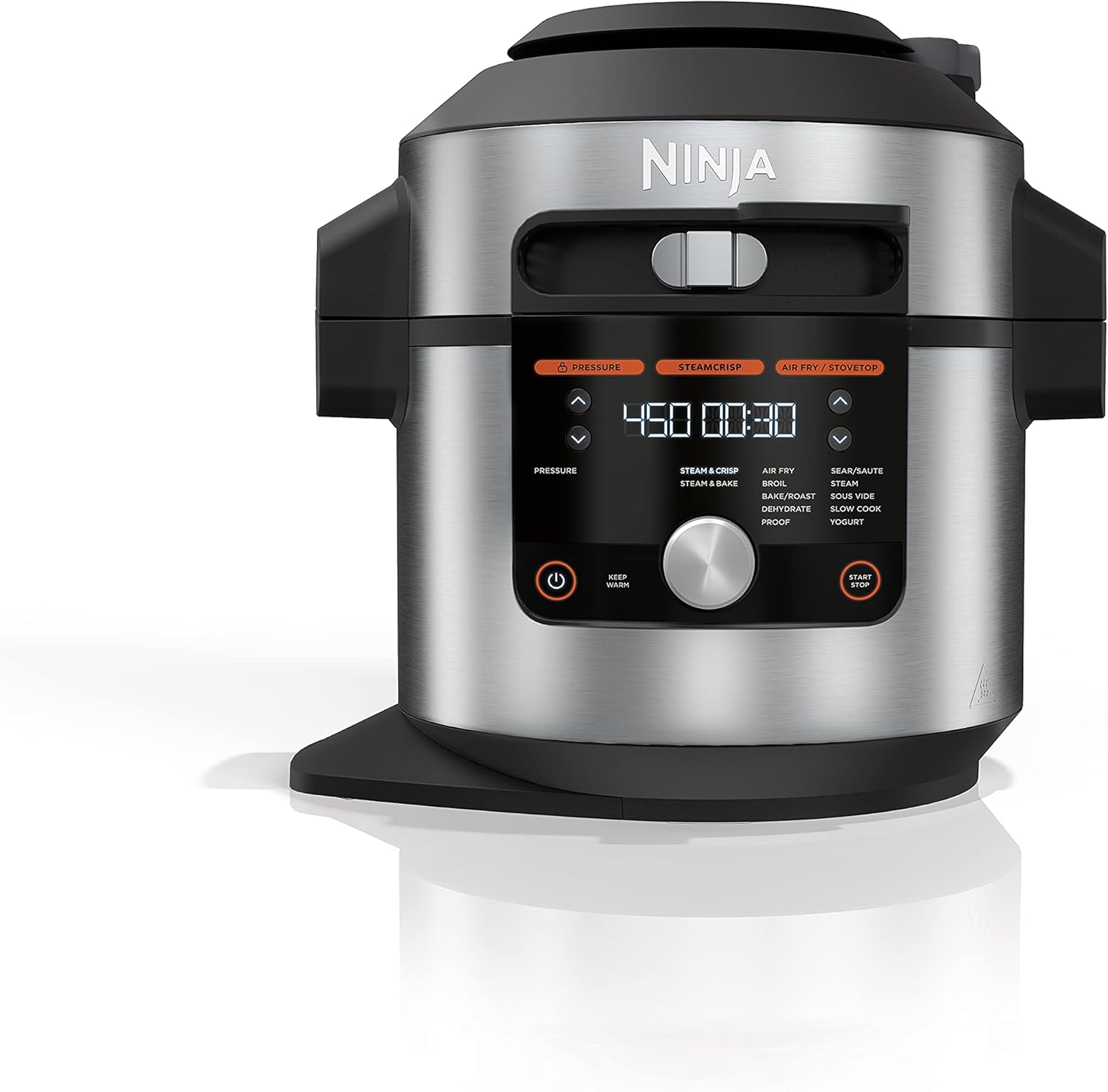
Short answer: These are not two products, they are two lid designs. Ninja’s current Foodi line uses one hinged SmartLid that pressure cooks and air fries without swapping anything. Instant Pot sells three different answers: a cheap pressure-only lid, a hinged single lid, and one machine that still ships two full lids. If you want pressure cooking and air frying in one appliance, the Ninja Foodi OL601 is the most usable version of that idea. If you only want pressure cooking, the Instant Pot Duo 6-quart is smaller, cheaper and better at it, and nothing on the Ninja side competes.
Below: what each lid design costs you in counter space, which machine you can actually open under a kitchen cabinet, and the 2025 recall that removed the original two-lid Foodi from shelves.
Quick Picks
| Best overall multi-cooker Ninja Foodi OL601 XL, 8 qt One hinged SmartLid, 1,760W, 5-quart crisp basket. The cleanest execution of pressure-plus-crisp. |
Check Price on Amazon |
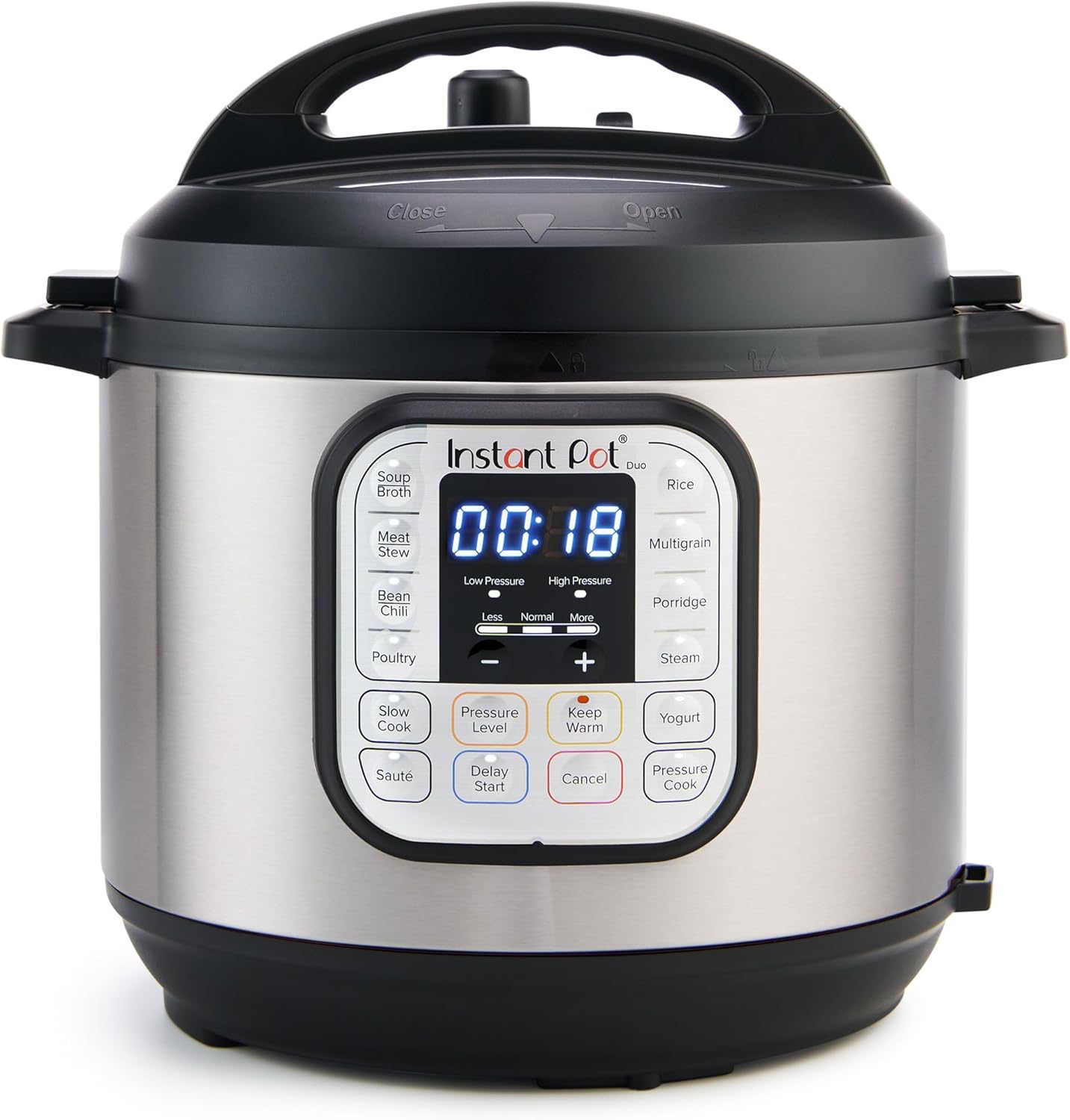
| Best if you only pressure cook Instant Pot Duo 7-in-1, 6 qt 163 sq in of counter, 11.8 lbs, tri-ply stainless pot. A quarter less counter than anything that air fries. |
Check Price on Amazon |
| Best Instant Pot that air fries Instant Pot Duo Crisp, Ultimate Lid, 6.5 qt Hinged single lid, stainless pot, dishwasher-safe basket. Instant Pot’s answer to the SmartLid. |
Check Price on Amazon |
| Best for cooking under a cabinet Instant Pot Duo Crisp 11-in-1, 8 qt The last two-lid machine. Both lids lift off, so nothing has to swing upward — but you must store a lid. |
Check Price on Amazon |
What is the actual difference between an Instant Pot and a Ninja Foodi?
The lid. Everything else follows from it. A Ninja Foodi has one hinged lid with a slider that mechanically reconfigures it between pressure cooking and air frying. An Instant Pot has whichever lid design its model was built around, and Instant Pot currently ships three different ones. Brand loyalty is irrelevant here; lid architecture is the whole decision.
This matters because a pressure lid and an air-frying lid want opposite things. A pressure lid must seal, lock, and hold roughly 11-12 PSI without leaking. An air-frying lid must contain a heating element and a fan, which means it needs a power connection and a lot of vent area. Getting both jobs out of one piece of hardware is genuinely hard, and the three ways manufacturers have solved it produce three very different appliances to live with.
The three lid designs currently sold
| Lid design | Who sells it | What you gain | What it costs you |
|---|---|---|---|
| One pressure lid, no air fry | Instant Pot Duo (and the newer RIO) | Smallest, lightest, cheapest, simplest. Lid lifts off entirely so the machine stores flat. | No crisping of any kind. You will still own an air fryer. |
| One hinged lid that does both | All current Ninja Foodi (OL501, OL601, OL701) and Instant Pot Duo Crisp with Ultimate Lid | Nothing to store, nothing to swap. Pressure cook then crisp in the same vessel without lifting the food out. | The lid is permanently attached and swings up and back, so the machine needs vertical clearance and cannot be shoved under a cabinet. |
| Two separate full lids | Instant Pot Duo Crisp 8QT only | Both lids lift clear off, so the base is short and slides under cabinets. Each lid is optimised for its one job. | You own a bulky corded air-fryer lid that has to live somewhere. Instant Pot ships a storage cover for it, which tells you how well that goes. |
Note what is not on that list: a two-lid Ninja. The original Ninja Foodi TenderCrisp (OP300 and OP400 series) used a removable pressure lid plus an attached crisping lid, and that is the design most older comparison articles are still describing. It was recalled in May 2025 and Ninja stopped selling it in March 2025. Details in the recall section below.
How much counter space does each one really take?
Far more than the quart number implies, and the quart number does not predict it. The Instant Pot Duo Crisp with Ultimate Lid holds 6.5 quarts and occupies 239 square inches of counter. The Ninja Foodi OL601 holds 8 quarts and occupies 219. The smaller machine takes more counter. Footprint tracks lid design, not capacity.
Two numbers matter that almost nobody publishes together. The first is usable capacity: every one of these machines has a MAX fill line at two-thirds of stated volume for pressure cooking, and a second line at one-half for foods that foam or expand — rice, beans, pasta, oats, split peas. An “8-quart” pressure cooker is a 5.3-quart pressure cooker, and a 4-quart one if you are cooking beans. The second is clearance to open, which decides whether the machine can live under your upper cabinets at all.
| Model | Stated | Max fill, liquids (2/3) | Max fill, rice & beans (1/2) | Counter footprint | Height, lid closed | Clearance to open (est.) | Buy |
|---|---|---|---|---|---|---|---|
| Instant Pot Duo | 6.0 qt | 4.0 qt | 3.0 qt | 13.4 × 12.2 in — 163 sq in | 12.5 in | ~15.5 in (lid lifts off) | Check Price |
| Instant Pot Duo Crisp 8QT | 8.0 qt | 5.3 qt | 4.0 qt | 13.6 × 14.8 in — 200 sq in | 15.3 in | ~18.3 in (both lids lift off) | Check Price |
| Instant Pot Duo Crisp, Ultimate Lid | 6.5 qt | 4.3 qt | 3.25 qt | 15.5 × 15.4 in — 239 sq in | 13.4 in | ~19 in (hinged, does not detach) | Check Price |
| Ninja Foodi OL501 | 6.5 qt | 4.3 qt | 3.25 qt | 15.4 × 14.2 in — 219 sq in | 13.1 in | ~18.5 in (hinged, does not detach) | Check Price |
| Ninja Foodi OL601 XL | 8.0 qt | 5.3 qt | 4.0 qt | 15.4 × 14.2 in — 219 sq in | 14.3 in | ~19.5 in (hinged, does not detach) | Check Price |
| Ninja Foodi OL701 SMART XL | 8.0 qt | 5.3 qt | 4.0 qt | 15.4 × 14.2 in — 219 sq in | 14.3 in | ~19.5 in (hinged, does not detach) | Check Price |
How to read the clearance column. Footprints, heights and capacities are the manufacturers’ own published figures. The clearance figure is derived, not measured — we add the lid’s own height to the closed height for hinged lids, and roughly three inches of lift for lids that detach. Treat it as a planning estimate, not a spec. The reference point that matters: the kitchen industry’s standard gap between a countertop and the upper cabinet above it is 18 inches.
Read against that 18-inch standard, the table says something none of these product pages will tell you. Only the plain Instant Pot Duo opens comfortably under a standard upper cabinet. Every machine here that air fries needs to be pulled forward, or needs to live on an open run of counter with nothing above it. If your only free counter is the strip under the cabinets, that single fact eliminates four of the six models before you compare anything else.
The second finding is a small money-saver: the Ninja 6.5-quart and the Ninja 8-quart occupy identical counter space. Both are 15.4 by 14.2 inches. Stepping down to the OL501 to “save room” buys you 1.2 inches of height and nothing else. If you were going to buy the smaller Ninja for space reasons, buy the OL601 instead and take the extra 1.3 quarts of usable capacity for free.
Which one actually air-fries better?
The Ninja Foodi, clearly, and the gap is structural rather than marginal. The OL601 runs 1,760W into a dedicated 5-quart crisp basket that sits above the pot floor, so hot air moves under and around the food. The Instant Pot Duo Crisp models run 1,500W. The plain Instant Pot Duo does not air fry at all, at any price, and no accessory changes that.
The reason is not just wattage. Ninja designed the Foodi around crisping from the beginning; Instant Pot added crisping to a pressure cooker. The Foodi’s basket is raised and vented, and the OL601 ships a three-layer rack so you can crisp on two levels. Instant Pot’s basket sits lower in a deeper, narrower vessel, which restricts airflow under the food.
Ninja’s Steam & Crisp mode has no Instant Pot equivalent. It injects steam during the crisping cycle, keeping the interior moist while the exterior browns — a meaningfully different result on chicken pieces and roasted vegetables, and the most-cited reason owners choose a Foodi over a Duo Crisp.
The honest caveat: no pressure-cooker-shaped vessel air fries as well as a purpose-built air fryer. The chamber is tall and round, which is the wrong geometry for single-layer crisping.
Which one gets to pressure faster?
The Ninja OL601 and the Instant Pot Duo Crisp models, by a wide margin over the plain Duo — because they draw 1,500 to 1,760 watts against the Duo’s 1,000. Time to pressure is essentially a function of wattage divided by the mass of liquid being heated, and the plain Duo is the only model here with a four-digit wattage figure that starts with a 1 and ends there.
Note what this does and does not change. Time to pressure is dead time before the cook timer starts; the cook time itself is set by pressure and is effectively identical across every model here, because all of them operate in the same 10-12 PSI band consumer electric pressure cookers are limited to. A recipe that says “20 minutes at high pressure” takes 20 minutes on all six.
Where wattage genuinely changes the experience is sauté and sear. Browning meat first is the step that decides whether a braise tastes like a braise or like boiled meat, and it is where the 1,000W Duo is weakest. Higher-wattage machines hold searing temperature better when cold meat hits the pot.
One counterpoint for the Duo: bigger machines are slower to pressure at equal fill levels, so a half-full 6-quart can beat a half-full 8-quart despite the wattage gap. If most of your cooking is small-batch, extra capacity is a tax you pay on every cook.
Which one is easier to clean?
The Instant Pot, on materials, and it is not close. Instant Pot uses an 18/8 tri-ply stainless steel inner pot that goes in the dishwasher, tolerates metal utensils, survives scouring pads and cannot be ruined by user error. Ninja uses a ceramic-coated nonstick pot that wipes clean more easily day to day but degrades if you scrub it, use metal tools, or run it through enough dishwasher cycles.
That is the trade in one sentence: nonstick is easier this week, stainless is easier in year three. A scratched ceramic coating is not repairable, and a replacement inner pot is a real recurring cost that the sticker price does not include. Stainless has no equivalent failure mode.
A second difference follows from the lid design and cuts the other way. On a hinged-lid machine — every Ninja Foodi and the Ultimate Lid Instant Pot — the lid cannot be removed and carried to the sink. You clean the underside, the element shroud and the gasket channel while the lid is attached to a 25-pound appliance, at whatever angle the hinge allows. On the two-lid Duo Crisp 8QT and the plain Duo, the lid comes off and goes to the sink.
Both brands share the sealing-ring problem: the silicone gasket absorbs odours, so a ring that has cooked curry will scent your next batch of yogurt. Own two, one savoury and one sweet, and replace them every 12 to 18 months. Budget for that on either brand.
Which is quieter when releasing steam?
The Ninja OL601 and OL701, because their steam release is mechanised and diffused rather than a manual valve you flip. On an Instant Pot Duo, quick-release means turning the valve by hand and getting a concentrated, loud jet of steam. On the Ninja, the release is engineered into the lid and vents through a wider diffuser, which spreads the same energy over a larger opening and lowers the pitch.
The OL701 adds auto steam release: it vents on its own at the end of the cycle without anyone standing over the machine with a wooden spoon. If you pressure cook near sleeping children or in a studio apartment, that is the main reason to pick the OL701 over the OL601.
Set expectations honestly: no consumer pressure cooker releases steam quietly. All of them vent pressurised steam through a small orifice, which is loud by physics. The gap here is between “startling” and “unpleasant”, not between loud and quiet. Natural release — letting pressure drop on its own over 10 to 20 minutes — is silent on every model, and is the correct method for most meats anyway.
Which is better for a family of four?
The 8-quart Ninja Foodi OL601, on capacity maths rather than preference. A family of four eating a one-pot meal with leftovers needs roughly 4 to 5 quarts of finished food. An 8-quart machine gives you 5.3 quarts of working volume. A 6-quart gives you 4.0. The 6-quart works; the 8-quart works without planning around it.
The constraint tightens sharply for the foods families actually batch-cook. Rice, beans, lentils, pasta and oatmeal all fall under the half-fill rule, which means a 6-quart Instant Pot Duo tops out at 3.0 quarts for a pot of chili beans, and an 8-quart tops out at 4.0. If weekly bean or grain batches are the reason you are buying a pressure cooker, the 8-quart is not a luxury, it is the size that fits the job.
Where the 6-quart wins is bulk and speed: 163 square inches versus 219, 11.8 pounds versus roughly 25, and faster to pressure at the same fill level. Our split — if you meal-prep on Sundays, buy 8-quart; if you cook dinner-sized portions on weeknights, buy 6-quart and put the difference toward a better knife.
Can you bake bread in either one?
Yes in a Ninja Foodi, no in a plain Instant Pot Duo, and yes with caveats in the Duo Crisp models. Baking needs dry radiant heat from above, which is exactly what an air-frying lid provides and exactly what a pressure lid cannot. Any machine on this page with a crisping element will bake; the pressure-only Duo will not.
The Ninja Foodi’s Bake/Roast plus Proof pairing is the most complete implementation: Proof holds a low, stable fermentation temperature for dough, and Bake/Roast then browns the top in the same vessel, so a no-knead loaf rises and bakes without moving. Both Duo Crisp models bake too, and the Ultimate Lid adds a proof function.
The real limitation is shape, not capability. You are baking inside a tall round pot roughly 8 to 9 inches across, so you get boules, small cakes, cornbread and casseroles — not a sandwich loaf, a sheet pan or a baguette. Browning is uneven too, since heat comes from one element directly overhead, so tops brown well ahead of sides. Treat baking as a genuine bonus, not an oven replacement.
Is it safe to buy a Ninja Foodi after the 2025 recall?
Yes — the recall covered the older two-lid TenderCrisp design, not the SmartLid models sold today. On May 1, 2025, SharkNinja recalled approximately 1.85 million Foodi OP300-series pressure cookers in the US, plus about 184,000 in Canada, because the pressure-cooking lid could be opened while the pot was still pressurised. No OL-series SmartLid model was included.
The specifics, because most comparison articles have not updated for this and it changes which used and clearance units you should avoid:
- Models recalled: OP300, OP301, OP301A, OP302, OP302BRN, OP302HCN, OP302HAQ, OP302HW, OP302HB, OP305, OP305CO and OP350CO — the 6.5-quart TenderCrisp line.
- Hazard: the pressure-cooking lid could be rotated open with contents still under pressure, releasing hot food and liquid.
- Injuries: 106 reported burn injuries, more than 50 of them second- or third-degree.
- Sold: January 2019 through March 2025, at Costco, Sam’s Club, Target, Walmart, Amazon and ninjakitchen.com.
- Remedy: stop using the pressure-cooking function and contact SharkNinja for a free replacement lid. Air frying and the other functions were not affected.
- Not included: the OL501, OL601 and OL701 SmartLid models, which use a different lid mechanism entirely.
Two practical consequences. If you already own an OP300-series Foodi, get the free replacement lid rather than replacing the machine. And if you are shopping: be cautious with heavily discounted “Ninja Foodi TenderCrisp” units on marketplaces, refurbished listings and clearance racks. That generation left production in March 2025, so remaining stock is old stock. Check the model number on the base plate before buying second-hand — if it starts OP, it is the recalled generation; if it starts OL, it is not.
What this does not mean: a recall handled publicly through CPSC with a free lid replacement is a manufacturer behaving correctly. It is not a reason to avoid the brand. It is a reason to know which generation you are buying.
Full comparison: Instant Pot vs Ninja Foodi
Instant Pot wins on pot material, footprint, price and simplicity. Ninja wins on crisping, capacity per square inch of counter, and steam release. The row that decides it for most buyers is the first one: whether you need the machine to crisp at all.
| Instant Pot Duo 6qt | IP Duo Crisp Ultimate Lid 6.5qt | IP Duo Crisp 8qt | Ninja Foodi OL601 8qt | |
|---|---|---|---|---|
| Air fries | No | Yes | Yes | Yes, best in class here |
| Lids | One, lifts off | One, hinged | Two, both lift off | One, hinged SmartLid |
| Functions | 7 | 13 | 11 | 14 |
| Wattage | 1,000W | 1,500W | 1,500W | 1,760W |
| Inner pot | Tri-ply stainless | Stainless | Stainless | Ceramic nonstick |
| Dishwasher-safe pot | Yes | Yes | Yes | Hand-wash advised |
| Counter footprint | 163 sq in | 239 sq in | 200 sq in | 219 sq in |
| Fits under an 18in cabinet | Yes | No | Marginal | No |
| Steam & Crisp mode | No | No | No | Yes |
| Weight | 11.8 lbs | ~24 lbs | ~22 lbs | ~25 lbs |
| Best for | Pressure cooking only, small kitchens | Instant Pot loyalists who want crisping | Cabinet clearance, batch cooking | One machine that does everything |
| Price | Check Price | Check Price | Check Price | Check Price |
Buy neither, if…
Multi-cookers are a compromise sold as an upgrade, and for three common cooking patterns a single-purpose appliance is straightforwardly better. If you recognise yourself below, spend the money on the specialist instead — you will get a better result and usually pay less.
You mostly want crispy food
Buy a basket air fryer. A pressure-cooker body is a tall round vessel, which is close to the worst possible shape for single-layer crisping; a purpose-built air fryer has a wide, shallow basket and moves air over a flat plane. It is also lighter, cheaper, faster to preheat and far easier to clean. Our Ninja vs Cosori air fryer comparison covers that decision, and the Cosori TurboBlaze 6.0-Quart is the pick there.
You already own an air fryer
Then the premise of a Foodi or Duo Crisp collapses. You would pay a premium and surrender 40 to 75 extra square inches of counter to duplicate an appliance already on that counter. Buy the plain Instant Pot Duo, keep the air fryer, and you end up with two machines each better at their job than one that does both — for less total money. Paying for a crisping lid you use twice a year is the most common mistake in this category.
You cook for one or two, occasionally
Consider a 3-quart mini instead, or a stovetop pressure cooker. The 6- and 8-quart machines here have minimum liquid requirements to reach pressure at all, which makes very small batches awkward, and the half-fill rule means a big pot cooking a little food is mostly heating air.
How we picked
We compared the current Instant Pot and Ninja Foodi multi-cooker lineups against manufacturer-published specifications, the CPSC and Health Canada recall notices, verified-buyer reports and current retail availability. We do not test appliances and this page makes no first-hand testing claims. Here is exactly what that means and where the numbers came from.
- Dimensions, wattage and capacity are the manufacturers’ own published figures, from instantpot.com product pages and Ninja’s OL501/OL601 documentation — not retailer listings, which often report shipping-box dimensions instead of appliance dimensions.
- Footprints are published width multiplied by published depth. Usable capacity comes from the two-thirds and one-half MAX fill lines both manufacturers mark inside the inner pot.
- Clearance-to-open figures are derived estimates, flagged as such, and should be checked against your own cabinets. Neither manufacturer publishes this number.
- Recall information comes from the May 1, 2025 SharkNinja recall as published by CPSC and Health Canada, including model numbers, injury counts and remedy.
- Generation checks. Every model recommended here was confirmed as currently sold on the manufacturer’s site or at a major US retailer in August 2026. Discontinued and recalled generations are named explicitly rather than quietly omitted.
- No prices are stated as fact. Multi-cooker pricing moves constantly and both brands discount heavily around Prime Day and Black Friday. Use the price links.
Frequently asked questions
Can a Ninja Foodi replace an Instant Pot?
Yes. Every current Ninja Foodi pressure cooks in the same 10-12 PSI band as an Instant Pot, so recipe times transfer directly with no conversion. You give up the stainless inner pot and about 56 square inches of counter compared with a plain Instant Pot Duo, and you gain air frying, baking and Steam & Crisp.
Can an Instant Pot replace an air fryer?
Only the Duo Crisp models, and only partly. The plain Instant Pot Duo has no crisping element and cannot air fry at any setting. The Duo Crisp and Duo Crisp with Ultimate Lid do air fry at 1,500W, but the tall round pot is a poor shape for single-layer crisping and neither matches a dedicated basket air fryer.
Does the Ninja Foodi really only have one lid?
The current models do. The OL501, OL601 and OL701 use a single hinged SmartLid with a slider that reconfigures it for pressure cooking, Steam & Crisp or air frying. The older OP300-series TenderCrisp Foodi used two lids, but that generation was recalled in May 2025 and discontinued in March 2025.
Which Ninja Foodi models were recalled?
The OP300 series: OP300, OP301, OP301A, OP302, OP302BRN, OP302HCN, OP302HAQ, OP302HW, OP302HB, OP305, OP305CO and OP350CO. Roughly 1.85 million units in the US were recalled on May 1, 2025 because the pressure lid could open while pressurised, after 106 reported burn injuries. The remedy is a free replacement lid from SharkNinja. No OL-series SmartLid model is affected.
What size Instant Pot or Ninja Foodi should I buy?
Work from usable capacity, not stated quarts. Pressure cookers fill to two-thirds for liquids and one-half for rice, beans and pasta, so a 6-quart holds 4.0 or 3.0 quarts and an 8-quart holds 5.3 or 4.0. A family of four batch-cooking grains or beans should buy 8-quart; a household cooking dinner-sized portions is better served by 6-quart, which reaches pressure faster and takes less counter.
Will an Instant Pot or Ninja Foodi fit under my kitchen cabinets?
Probably not, if it air fries. The standard countertop-to-upper-cabinet gap is 18 inches. Only the plain Instant Pot Duo, at 12.5 inches closed with a lid that lifts off, opens comfortably in that space. Hinged-lid machines — every Ninja Foodi and the Duo Crisp with Ultimate Lid — need roughly 18.5 to 19.5 inches to swing the lid back and must be pulled forward to use.
The bottom line
Decide on the lid first and the brand second. If you want one appliance that pressure cooks and genuinely crisps, the Ninja Foodi OL601 executes that idea better than anything Instant Pot sells: more power, a raised crisp basket, Steam & Crisp, quieter venting, and 8 quarts in the same footprint Ninja uses for 6.5. Move up to the OL701 only if auto steam release and the probe thermometer are worth it to you.
If you want a pressure cooker, buy a pressure cooker. The Instant Pot Duo 6-quart uses a quarter less counter than anything here that air fries, weighs less than half as much, has the better inner pot, is the only model on this page that opens under a standard upper cabinet, and costs the least. And if the counter is already crowded, the honest answer may be neither — a plain pressure cooker plus the air fryer you already own beats one machine that compromises at both.
Check Ninja Foodi OL601 Price
Check Instant Pot Duo Price
Related reading: Ninja vs Cosori air fryers · Best kitchen gadgets under $50
Related guides
Keep reading

As an Amazon Associate, Save & Upgrade earns from qualifying purchases. Prices and availability are accurate as of the date noted and are subject to change.
Leave a Reply