

In this guide
- Quick Picks
- What is the capacity difference between Cosori and Ninja air fryers?
- Quick comparison: the three models most people are deciding between
- How we compared these air fryers
- Which air fryer is quieter, Ninja or Cosori?
- Which basket is easier to clean, Ninja or Cosori?
- Which has the better app and presets, Ninja or Cosori?
- Which holds heat better when you open the basket?
- Which is better for a family of four?
- Ninja AF101 4-Quart Air Fryer — full review
- Cosori Pro Gen 2 5.8-Quart Air Fryer — full review
- Cosori TurboBlaze 6.0-Quart — the model that changed this comparison
- Cosori vs Ninja head-to-head: who wins each category
- Buy neither, if…
- What it actually costs to own one
- Frequently asked questions
- Verdict: which air fryer should you buy?
- Related comparisons
- Related guides
Last updated: August 3, 2026.
What changed in this update: added the Cosori TurboBlaze 6.0-Quart (Cosori’s current flagship, which did not exist when this page was first written) and the Ninja Max XL AF161, DualZone DZ201 and DoubleStack XL SL401; added a full quart-by-quart capacity table with published basket floor dimensions for both lineups; added a “buy neither” section; removed all fixed prices and star ratings, which go stale within weeks.
Short answer: Cosori gives you more usable cooking floor per stated quart, quieter operation and a much better app. Ninja gives you simpler controls, a tougher basket coating and better two-zone options if you cook two things at once. For most single-basket buyers in 2026 the Cosori TurboBlaze 6.0-Quart is the better machine; the Ninja AF101 is still the best small, cheap, no-nonsense pick.
This Cosori vs Ninja comparison covers the full current lineups from both brands, not just the two models that used to dominate this page — plus the one category where a third brand, Instant, beats them both.
Part of our Kitchen buying guides — which appliances earn their counter space.
Quick Picks
| Best overall (2026) Cosori TurboBlaze 6.0-Quart Biggest usable floor in a single basket, 90°–450°F, PFAS-free ceramic, quietest of the group. |
Check Price on Amazon |
| Best small & simple Ninja AF101 4-Quart Four buttons, 10 lbs, 105°F dehydrate floor. The easiest first air fryer to own. |
Check Price on Amazon |
| Best value for a family of four Cosori Pro Gen 2 5.8-Quart The widest basket floor of any model here, usually the cheapest way to get it. |
Check Price on Amazon |
| Best for cooking two things at once Ninja DoubleStack XL SL401 Two 5-quart zones stacked vertically, so it takes a single-basket footprint. |
Check Price on Amazon |
What is the capacity difference between Cosori and Ninja air fryers?
Cosori consistently gives you more usable cooking floor per stated quart than Ninja, because Cosori uses square baskets and publishes their dimensions while Ninja mostly uses round or tapered baskets and does not. A Cosori Pro Gen 2 rated at 5.8 quarts has about 90 square inches of basket floor. A Ninja AF101 rated at 4 quarts has about 54. That is 69% more floor for 45% more stated capacity — the gap is bigger than the quart numbers suggest.
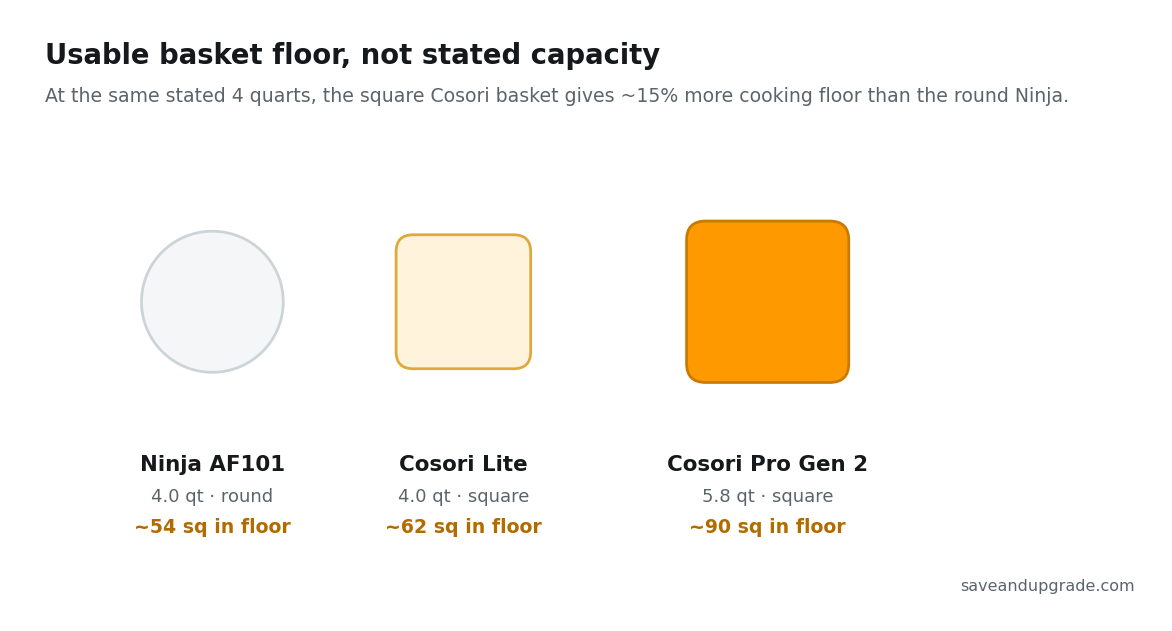
Stated quarts measure the volume of the whole cavity, including the tapered walls and the headroom above the food. That tells you almost nothing about how many chicken thighs fit in one layer, which is what you actually care about — air fryers cook by moving hot air around food, so anything stacked or overlapping cooks unevenly. The number that predicts real capacity is the floor area of the crisper plate.
| Model | Stated capacity | Basket shape | Basket floor (published) | Floor area | Realistic single-layer servings | Buy |
|---|---|---|---|---|---|---|
| Ninja AF101 | 4.0 qt | Round, ceramic-coated plate | 8.25 in diameter × 3.75 in deep | ~54 sq in | 2 | Check Price |
| Ninja Max XL AF161 | 5.5 qt | Square-ish, non-stick | ~8.75 in × 8.75 in × 4.5 in deep | ~77 sq in | 3 | Check Price |
| Ninja DualZone DZ201 | 8.0 qt (2 × 4.0) | Two separate baskets | Not published by Ninja | Two ~4 qt floors | 2 + 2, cooked differently | Check Price |
| Ninja DoubleStack XL SL401 | 10.0 qt (2 × 5.0) | Two stacked baskets | Not published by Ninja | Two ~5 qt floors | 4, or two 5-lb chickens | Check Price |
| Cosori Lite 4.0-Quart | 4.0 qt | Square, non-stick | 7.9 in × 7.9 in × 4.3 in deep | ~62 sq in | 2–3 | Check Price |
| Cosori Pro Gen 2 | 5.8 qt | Square, detachable non-stick | 9.5 in × 9.5 in × 3.8 in deep | ~90 sq in | 4 | Check Price |
| Cosori TurboBlaze 6.0-Quart | 6.0 qt | Square, PFAS-free ceramic | 9.3 in × 9.3 in × 4.5 in deep | ~87 sq in | 4–5 | Check Price |
| Cosori Dual Blaze 6.8-Quart | 6.8 qt | Square, ceramic, dual heaters | Not published by Cosori | Larger than Pro Gen 2 | 4–6 | Check Price |
| Cosori Dual Basket 9.0-Quart | 9.0 qt (2 × 4.5) | Two separate baskets, windows | Not published by Cosori | Two ~4.5 qt floors | 4–6, cooked two ways | Check Price |
Floor areas are calculated from published basket dimensions. Where a manufacturer does not publish basket dimensions we say so rather than estimating. Servings assume one layer of a standard protein portion with no overlap.
The three capacity comparisons that actually matter
- Same stated quarts, different real capacity. The Cosori Lite 4.0-Quart and the Ninja AF101 are both sold as 4-quart machines. The Cosori has roughly 15% more floor because it is square. Nothing about the quart rating tells you that.
- The 5.5–6 quart class is where Cosori pulls ahead. Ninja’s Max XL is rated 5.5 quarts with about 77 square inches of floor. Cosori’s Pro Gen 2 is rated 5.8 quarts with about 90 — a 17% bigger single layer for a 5% bigger number on the box.
- Above 8 quarts, both brands stop being one air fryer. Every model over 8 quarts from either brand is two smaller baskets in one housing. A DualZone DZ201 is not an 8-quart air fryer; it is two 4-quart air fryers. If you want one very large single layer for a sheet-pan-sized batch, neither brand sells it — see the “buy neither” section below.
Quick comparison: the three models most people are deciding between
| Spec | Ninja AF101 | Cosori Pro Gen 2 | Cosori TurboBlaze 6.0 |
|---|---|---|---|
| Stated capacity | 4 qt | 5.8 qt | 6.0 qt |
| Basket floor area | ~54 sq in | ~90 sq in | ~87 sq in |
| Wattage | 1,550W | 1,700W | 1,725W |
| Temperature range | 105°F–400°F | 170°F–400°F | 90°F–450°F |
| Functions | 4 | 13 one-touch presets | 9, plus 5 fan speeds |
| Motor | AC | AC | DC, variable speed |
| Basket coating | Ceramic-coated crisper plate | Non-stick, detachable | PFAS-free ceramic |
| Smart features | None | VeSync app, Alexa, Google | None on base model |
| Weight | 10 lbs | 11.9 lbs | ~13 lbs |
| Overall dimensions | 13 × 11 × 14 in | 11.7 × 14.2 × 12.6 in | 11.8 × 14.4 × 11.9 in |
| Warranty | 1 year | 1 year | 1 year (2 with registration) |
| Typical street price, Aug 2026 | $70–100 range | $90–110 range | $100–140 range |
| Best for | 1–2 people, first air fryer | Families wanting max floor per dollar | Anyone who wants the best single basket |
| Buy | 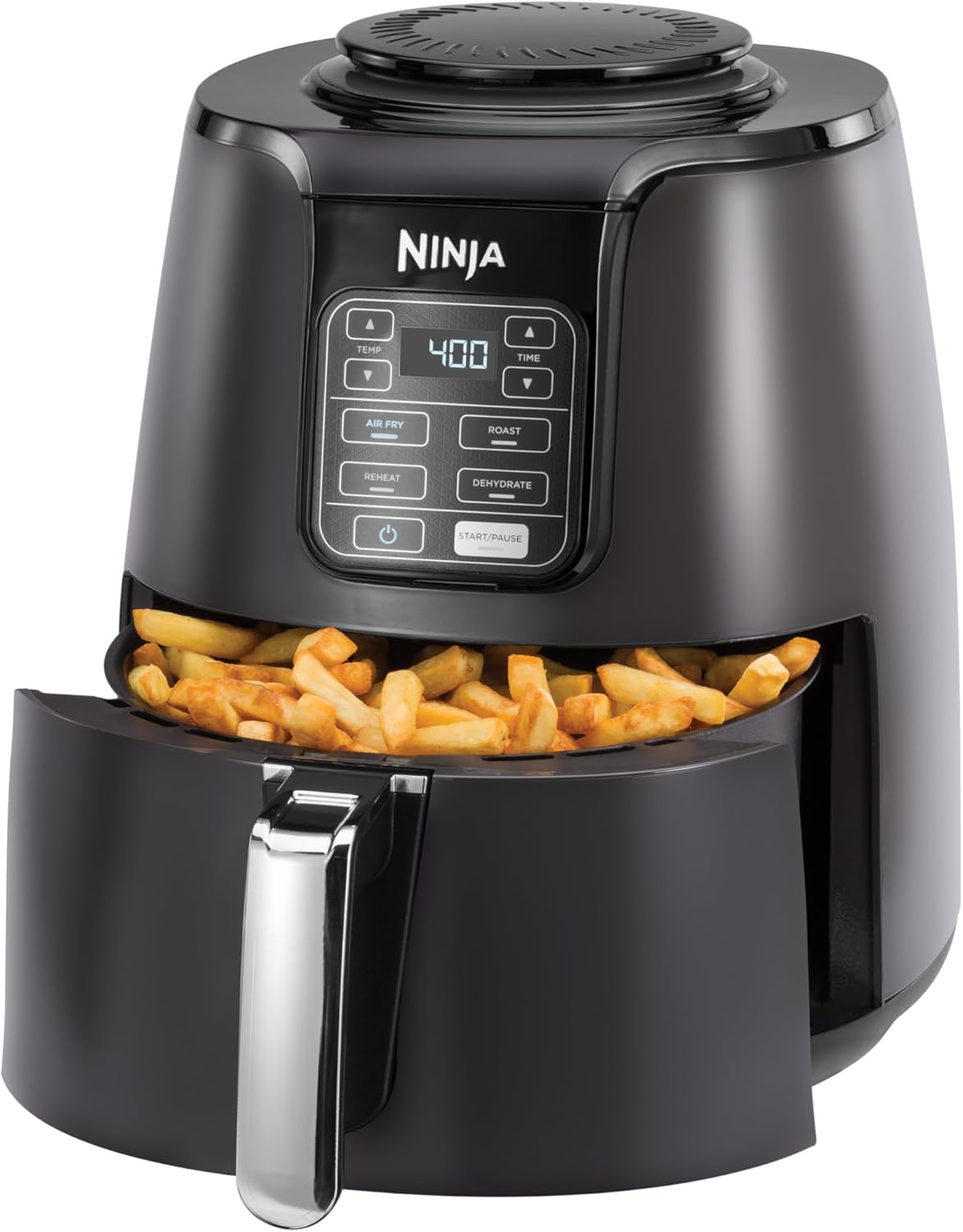 Check Price Check Price |
 Check Price Check Price |
Check Price |
How we compared these air fryers
We did not cook in these machines. This comparison is built from manufacturer specification sheets, published measurements from independent testing outlets, owner’s manuals, verified-buyer reports and current retail listings, all re-checked in August 2026. Where a number is calculated rather than published — basket floor area, for instance — we show the dimensions it came from so you can check the arithmetic.
What we deliberately do not do is quote star ratings or fixed prices. Both change weekly and are the first thing to go stale on a comparison page. Use the buttons to see what the listing says today.
Which air fryer is quieter, Ninja or Cosori?
Cosori, and the gap is widest with the TurboBlaze. Ninja’s basket models run around 70–72 dB at full fan — loud enough to talk over in an open kitchen. Cosori’s AC-motor models sit a few decibels lower. The TurboBlaze is the quiet one in the group because its DC motor lets you drop to a lower fan speed instead of running flat out on every cook.
Decibels are logarithmic, so a 4 dB gap is more noticeable than it sounds — roughly the step from a busy restaurant to a normal conversation. It matters in three situations: open-plan kitchens where the fryer is effectively in the living room, households with a baby sleeping nearby, and long dehydrate cycles that run for six hours. If none apply, noise should not decide this purchase.
Which basket is easier to clean, Ninja or Cosori?
Cosori, for everyday cleaning; Ninja, for long-term coating survival. Cosori’s square detachable basket separates from the crisper plate, so you can get a sponge into every corner and both parts go in the dishwasher flat. Ninja’s round basket has a fixed geometry that traps grease where the wall meets the floor. But Ninja’s ceramic crisper plate resists scratching better than a standard non-stick liner.
The exception is the TurboBlaze, which is Cosori’s answer to exactly this criticism: it uses a PFAS-free ceramic coating, so it gets Cosori’s square detachable design and a coating that survives daily use. If cleaning is high on your list, that is the model to look at.
Whichever you buy, coating life is mostly down to you. Metal tongs, aerosol cooking sprays and abrasive sponges kill non-stick faster than anything the manufacturer did. Silicone utensils, oil from a brush rather than an aerosol, and hand-washing will roughly double the useful life of any basket here.
Which has the better app and presets, Ninja or Cosori?
Cosori, decisively — Ninja does not have an app on any of these basket models. Cosori’s VeSync app handles remote start and monitoring, a large recipe library and voice control through Alexa and Google Assistant. Ninja’s basket air fryers are all physical controls only. If app control is on your list, this comparison is already over.
Presets are a different question. The Pro Gen 2 has 13 one-touch functions, the TurboBlaze has 9 plus five fan speeds, the AF101 has 4. More presets genuinely helps in a household where several people cook at different skill levels — press “bacon” and stop thinking. But experienced users end up setting time and temperature manually anyway, at which point 13 buttons is 13 buttons to read past. The TurboBlaze’s fan-speed control is the more interesting feature: a low fan is what makes baking and proofing work in an air fryer, and no Ninja basket model offers it.
Which holds heat better when you open the basket?
The TurboBlaze recovers fastest, then the Pro Gen 2, then the Ninja models. Recovery time is driven by wattage and by how much of the cavity is metal that stays hot. TurboBlaze runs 1,725W, Pro Gen 2 runs 1,700W, and the Ninja AF101 runs 1,550W. Every air fryer loses most of its heat the moment you pull the basket to shake it.
In practice this matters less than the spec sheet implies: you lose 30–60 seconds per shake on any of them, and the recipe already assumed you would shake. It becomes real in batch cooking — four consecutive loads of wings finish measurably sooner on the higher-wattage machine, because it is not spending the first two minutes of each load climbing back to temperature. Cosori’s Dual Blaze removes the shake entirely by heating from top and bottom, which is a legitimate reason to pick it over the TurboBlaze if you cook a lot of vegetables.
Which is better for a family of four?
The Cosori Pro Gen 2 or TurboBlaze if you want one basket, the Ninja DoubleStack XL if you want a main and a side finishing together. A family of four needs roughly 85–90 square inches of basket floor to cook four proteins in one layer. Only the Pro Gen 2 (~90) and TurboBlaze (~87) clear that in a single basket. The Ninja AF101 does not come close.
The honest question is whether you want one big layer or two independent zones. One layer is simpler, cheaper and easier to store, and it is right if you mostly cook one thing. Two zones cost more and take more counter, but they solve the actual weeknight problem: the protein and the vegetable want different temperatures and times, and with one basket you cook them sequentially and eat the first one lukewarm.
If you land on two zones, the Ninja DoubleStack XL SL401 is the one to look at, because it stacks its two 5-quart baskets vertically rather than side by side. Side-by-side machines like the DZ201 are enormous on a counter; the DoubleStack takes roughly a single-basket footprint and goes up instead of out. That is the difference between owning one and storing one.
Ninja AF101 4-Quart Air Fryer — full review
Still the best small air fryer to buy in 2026, and still current generation. Ninja has not replaced the AF101 — it remains in the active lineup at Amazon, Target, Home Depot and Ninja’s own store. It does four things, does them without a setup process, weighs 10 lbs and fits under a cabinet.
Specs
- Capacity: 4 quarts, round basket, 8.25 in diameter × 3.75 in deep (~54 sq in floor)
- Wattage: 1,550W
- Temperature range: 105°F–400°F
- Functions: Air Fry, Roast, Reheat, Dehydrate
- Basket: Ceramic-coated crisper plate, dishwasher-safe
- Dimensions: 13 × 11 × 14 in | Weight: 10 lbs | Warranty: 1 year limited
Pros
- The 105°F dehydrate floor is genuinely low. Most air fryers stop at 170°F, hot enough to cook jerky rather than dry it. Across both brands’ AC-motor models, the AF101 is the one that actually dehydrates; only the TurboBlaze goes lower.
- Ceramic crisper plate, more scratch-resistant than the PTFE liners on most machines in this price band, and it does not flake under normal use.
- Small and light enough to actually put away. At 10 lbs it goes in a lower cupboard one-handed. The 5–6 quart machines here mostly become permanent counter residents.
- Four buttons. No app, no account, no firmware. For a gift or a first air fryer that is a feature, not a limitation.
- One of the most-reviewed air fryers on Amazon, with tens of thousands of verified-buyer reports behind it — useful because failure modes surface in that volume long before they surface anywhere else.
Cons
- 54 square inches is two servings, full stop. Not three with effort. Two.
- Round basket wastes the corners. Flat foods — fish fillets, chicken cutlets, toast — fit worse than the quart rating implies.
- Loudest of the group at roughly 72 dB.
- No app, no fan-speed control, 400°F ceiling. Cosori’s TurboBlaze reaches 450°F, which matters for finishing and broiling.
Who it’s for
Singles, couples, students, RV and small-apartment kitchens, and anyone buying their first air fryer who wants to find out whether they will use it before spending more. Also the right pick if dehydrating is a real part of why you are buying.
Cosori Pro Gen 2 5.8-Quart Air Fryer — full review
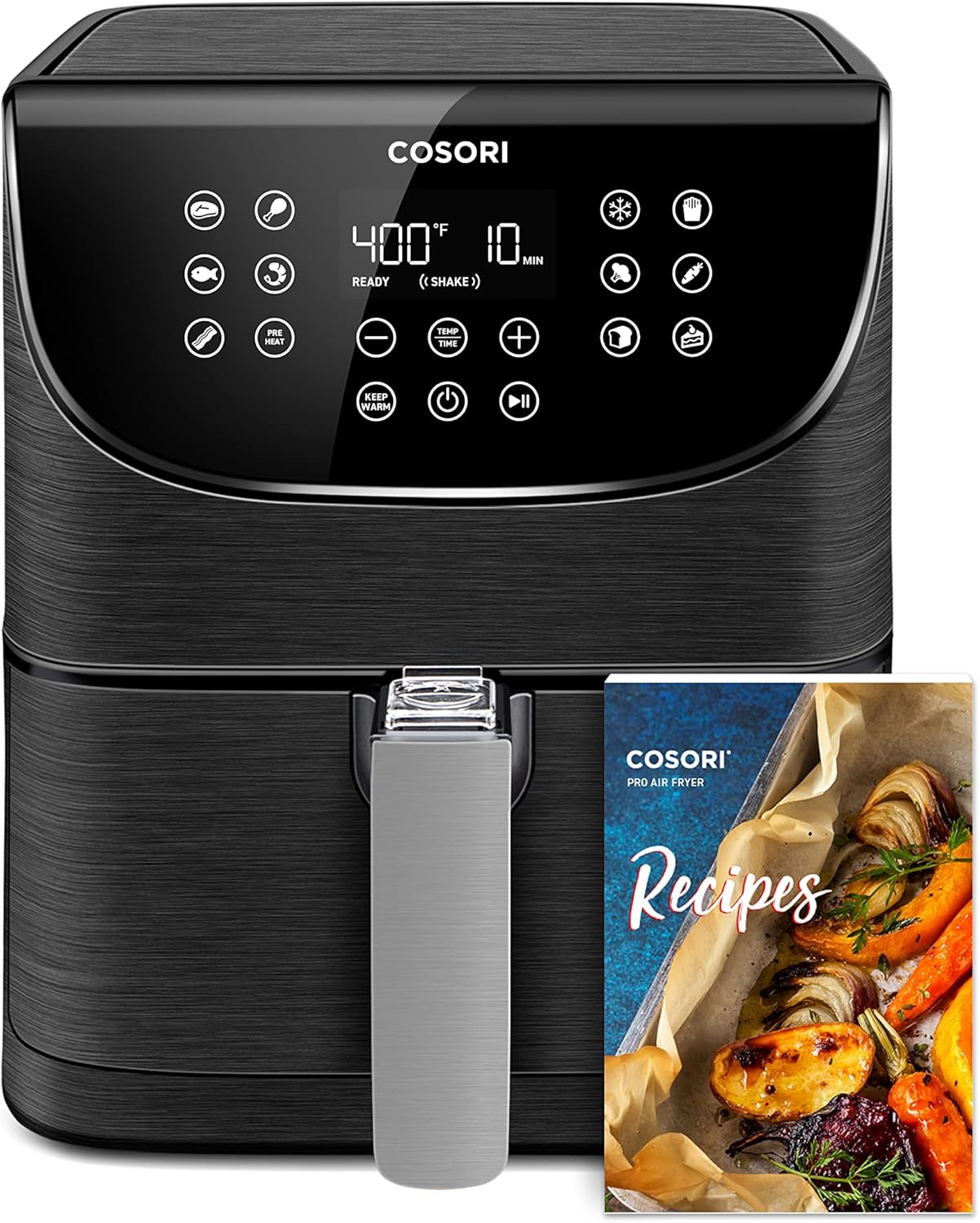
No longer Cosori’s flagship, and that is exactly why it is the value pick. The TurboBlaze took over the top of the range, which has pushed the Pro Gen 2 into the price band where it is the cheapest way to get roughly 90 square inches of basket floor — more than any other model in this comparison, including the newer TurboBlaze.
Specs
- Capacity: 5.8 quarts, square detachable basket, 9.5 × 9.5 × 3.8 in (~90 sq in floor)
- Wattage: 1,700W | Temperature range: 170°F–400°F
- Functions: 13 one-touch presets including Steak, Chicken, Seafood, Shrimp, Frozen, Fries, Bacon, Vegetables, Toast, Bake, Preheat and Keep Warm
- Smart features: VeSync app (iOS/Android), Alexa, Google Assistant
- Dimensions: 11.7 × 14.2 × 12.6 in | Weight: 11.9 lbs | Warranty: 1 year limited
Pros
- Widest basket floor here. 9.5 inches square takes four chicken thighs or four salmon fillets in one layer, which is the whole reason to buy a 5–6 quart machine.
- Detachable basket and crisper plate, which separate for cleaning — the biggest practical difference from Ninja’s fixed round basket.
- 13 presets and a real app. Voice control and remote monitoring work as advertised, and the recipe library is useful rather than decorative.
- Redesigned airflow versus the original Pro. The Gen 2 revision was specifically about reducing hot spots, which is why it still holds up against newer competition.
- Best price per square inch in the comparison now that it sits below the TurboBlaze in the range.
Cons
- Shallow basket. 3.8 inches is the shallowest of the 5–6 quart machines here. Great for a single layer, poor for a whole chicken or anything tall.
- 170°F floor rules out dehydrating. If jerky is on your list, this is the wrong machine.
- Standard non-stick, not ceramic. Long-term owners do report coating wear at the 12–18 month mark under heavy daily use. Hand-washing and silicone utensils make a large difference here.
- 400°F ceiling and no fan speed control. The TurboBlaze beats it on both.
Who it’s for
Families of three to five who want the most single-layer cooking area per dollar and will use the app. If you can find it noticeably cheaper than the TurboBlaze, it is the better buy on value; if the two are close in price, buy the TurboBlaze.
Cosori TurboBlaze 6.0-Quart — the model that changed this comparison
The TurboBlaze 6.0 is the best single-basket air fryer either brand sells, and Cosori’s best-seller — a model that did not exist when this page was first written. It is Cosori’s first air fryer with a DC motor, which is what unlocks five selectable fan speeds, a 90°F–450°F range and materially quieter operation than anything else in this comparison.
Specs
- Capacity: 6.0 quarts, square basket, 9.3 × 9.3 × 4.5 in (~87 sq in floor, deepest here)
- Wattage: 1,725W | Temperature range: 90°F–450°F
- Functions: 9 — Air Fry, Roast, Bake, Broil, Dehydrate, Frozen, Proof, Reheat, Keep Warm — plus 5 fan speeds
- Basket: PFAS-free ceramic coating, dishwasher-safe
- Dimensions: 11.8 × 14.4 × 11.9 in including handle
Why it matters
Three of those specs change the Ninja-versus-Cosori argument outright. The 90°F floor removes the one thing Ninja’s AF101 uniquely did well — low-temperature dehydrating — and does it better. The 450°F ceiling is 50°F above every other model here, the difference between browning a steak crust and steaming it. And PFAS-free ceramic answers the durability complaint that has followed Cosori’s non-stick baskets for years. At 4.5 inches it is also the deepest basket in this comparison, and the only 6-quart-class single basket here that takes a whole chicken comfortably.
The trade-off: the base TurboBlaze has no app. Cosori sells a Smart version with VeSync connectivity as a separate listing, so check which one you are looking at if voice control matters.
Cosori vs Ninja head-to-head: who wins each category
- Cooking performance — Cosori. Everyday food comes out close enough that nobody would call it blind, but square baskets keep food flat instead of curling it up a round wall, and the TurboBlaze’s 450°F setting is the one meaningful performance advantage anywhere in this comparison.
- Ease of use — Ninja, decisively. Four buttons versus 13 presets, an app and an account. If the person using this machine is not interested in appliances, buy the Ninja.
- Cleaning — Cosori, via the TurboBlaze, which pairs the detachable square basket with a ceramic coating that survives daily use.
- Value — split. Cosori wins on price per square inch of usable floor at every size; Ninja’s AF101 wins on absolute lowest cost of entry.
- Durability and support — tie. Both offer one-year limited warranties, with Cosori extending to two years on registration for some models. Ninja’s replacement-part availability is broader simply because more units are in circulation. Neither brand’s service reputation should decide this purchase.
Buy neither, if…
A basket air fryer is the wrong appliance for a meaningful number of people, and no amount of comparing Ninja to Cosori fixes that. Buy a toaster-oven-style air fryer instead if any of the following describe you — you will be happier and you will use it more often.
- You want to cook flat things. Pizza, garlic bread, quesadillas, a tray of cookies, six slices of toast. A basket is the wrong shape for all of them. A countertop air-fry oven like the Ninja SP101 Digital Air Fry Oven takes a 13-inch pizza and flips up against the backsplash when you are done.
- You already own a toaster. An air-fry oven replaces the toaster, so it is net-zero on counter space. A basket fryer is pure addition — and 14 inches deep of it.
- You cook for six or more. The largest true single layer available in a basket is around 90 square inches. A mid-size air-fry oven gives you a half-sheet pan. Two 4.5-quart zones is not the same thing as one large tray.
- You want to see the food. Basket fryers are opaque; you pull the drawer to check, which drops the temperature. Ovens have a window and a light.
- You cook for one and rarely. If the honest answer is frozen fries twice a month, the appliance you want is a 2-quart mini or nothing at all. A 6-quart machine that lives in a cupboard is not a bargain at any price.
Where a basket fryer genuinely wins: it preheats faster than any oven, it is far easier to clean because you wash one basket rather than racks and a crumb tray, and it crisps small volumes better because air moves faster in a smaller cavity. If you mostly cook one or two portions, the basket is right and this comparison applies to you. If you are feeding a household, look hard at an oven first.
And if what you want is to see the food, the third brand takes that one category outright. Neither Ninja nor Cosori sells a basket model you can see into, so in a Cosori vs Ninja vs Instant comparison the Instant Vortex Plus 6QT ClearCook wins on visibility by default — its window lets you judge browning without pulling the drawer and dumping the cavity heat. On paper it sits between the two: 1,700W and 6 quarts like the Cosori TurboBlaze, but a 95°F–400°F range against the TurboBlaze’s 90°F–450°F, and no selectable fan speeds. Buy Instant if watching the food matters more to you than top-end browning; on temperature range and usable floor the Cosori is still the better machine.
What it actually costs to own one
Budget for one basket replacement over a five-year life, and effectively nothing else. Air fryers have no filters, no descaling, no consumables. The only part that wears out is the basket coating, and third-party replacement baskets for both brands sit in the $20–35 range depending on model.
Running cost is small but not zero. A 1,700W machine at full power for 20 minutes uses roughly 0.57 kWh — a few cents at typical US rates, and far less than heating a full-size oven for the same job. The real saving is time: an oven takes 10–15 minutes to preheat and every machine here does it in two to four.
The cost nobody mentions is counter space. All three main models occupy roughly a foot square and stand 12–14 inches tall, which in most kitchens means displacing something. Measure, including clearance above and behind for the exhaust, before you order. This is the single most common reason these machines end up in a cupboard and then on a resale listing.
Frequently asked questions
What is the capacity difference between Cosori and Ninja air fryers?
Cosori gives you more usable cooking floor per stated quart. A 5.8-quart Cosori Pro Gen 2 has a 9.5 × 9.5 inch basket floor, about 90 square inches. A 4-quart Ninja AF101 has an 8.25-inch round floor, about 54 square inches. Even comparing equal stated capacities — the 4-quart Cosori Lite versus the 4-quart Ninja AF101 — the square Cosori basket has roughly 15% more floor area.
Is Ninja or Cosori better?
Cosori is the better machine for most buyers in 2026: more usable basket area per quart, quieter operation, a working app, and the TurboBlaze’s 90°F–450°F range beats anything Ninja offers in a basket. Ninja is better if you want the simplest possible appliance, the lowest entry price, or two independent cooking zones in a small footprint.
Which is better, Ninja AF101 or Cosori?
The AF101 wins on price, size, weight and simplicity, and it is the only Ninja basket model that dehydrates properly at 105°F. Any 5–6 quart Cosori beats it on capacity, noise, presets and app support. If you cook for one or two people and want to spend as little as possible, buy the AF101. Otherwise buy the Cosori.
Cosori vs Ninja air fryer — which lasts longer?
Both carry one-year limited warranties, with Cosori offering two years on registration for some models. Ninja’s ceramic-coated crisper plate historically outlasts standard non-stick liners, but Cosori’s TurboBlaze now uses PFAS-free ceramic and closes that gap. In practice, coating life depends far more on how you treat it — silicone utensils, no aerosol sprays, no abrasive sponges — than on which brand is on the front.
Can a Cosori air fryer cook a whole chicken?
Yes. The TurboBlaze’s 6-quart basket at 4.5 inches deep is the best fit of the models here for a 5-lb bird. The Pro Gen 2’s 5.8-quart basket will also take one, though at 3.8 inches deep it is tight. The Ninja AF101 at 4 quarts cannot. Ninja’s DoubleStack XL will take two whole chickens, one per zone.
Does Cosori or Ninja preheat faster?
Cosori, by a small margin. The TurboBlaze runs 1,725W and the Pro Gen 2 1,700W against the Ninja AF101’s 1,550W, which works out to roughly one to two minutes’ difference to a high target temperature. Cosori states the TurboBlaze’s DC motor cooks up to 46% faster than its previous generation. Both brands preheat far faster than a conventional oven, and for a single meal the difference between them is not something you would notice.
How does Instant’s Vortex compare to Cosori and Ninja?
The Instant Vortex Plus 6QT ClearCook is the only one of the three brands with a window you can see the food through, which matters most while you are learning a new machine. On specification it sits between them: 1,700W and 6 quarts like the Cosori TurboBlaze, but a 95°F–400°F range against the TurboBlaze’s 90°F–450°F, and no selectable fan speeds. Choose Instant for visibility, Cosori for temperature range and basket floor, Ninja for the lowest entry price.
Is the Ninja AF101 still worth buying in 2026?
Yes, if the size suits you. It is still in Ninja’s active lineup and sold at all major retailers, it has not been superseded within Ninja’s 4-quart class, and nothing about air frying has changed enough in the last two years to make it obsolete. It is a compact, simple, current-generation appliance, not old stock.
Which Ninja or Cosori air fryer is best for a family of four?
The Cosori TurboBlaze 6.0-Quart or Pro Gen 2 5.8-Quart if you want one basket, because they are the only models here with enough floor area — roughly 87–90 square inches — to cook four proteins in a single layer. The Ninja DoubleStack XL SL401 if you would rather cook a main and a side at different temperatures simultaneously and finish them together.
Verdict: which air fryer should you buy?
- Buy the Cosori TurboBlaze 6.0-Quart if you want the best single-basket air fryer either brand sells right now. The widest useful temperature range, the deepest basket, ceramic coating, variable fan speed and the quietest operation in the group.
- Buy the Cosori Pro Gen 2 5.8-Quart if you want the most basket floor per dollar and will use the VeSync app. It has the widest floor here and now sits below the TurboBlaze on price.
- Buy the Ninja AF101 4-Quart if you cook for one or two, want the simplest machine and the lowest price, or specifically want to dehydrate at 105°F.
- Buy the Ninja DoubleStack XL SL401 if you need two independent zones without giving up half your counter.
- Buy neither if you mostly cook flat food, feed six or more, or already own a toaster you would rather replace. Get a countertop air-fry oven.
| Ninja AF101 | Cosori Pro Gen 2 | Cosori TurboBlaze 6.0 | |
|---|---|---|---|
| Best for | 1–2 people | 3–5 people, best value | 3–5 people, best overall |
| Usable basket floor | ~54 sq in | ~90 sq in | ~87 sq in, 4.5 in deep |
| Standout spec | 105°F dehydrate | 9.5 in square basket | 90–450°F, 5 fan speeds |
| Verdict | Best compact pick | Best value pick | Best overall pick |
| Buy | Check Price | Check Price | Check Price |
Related comparisons
- Instant Pot vs Ninja Foodi — the same head-to-head question one appliance over. If you are choosing between a pressure cooker and a multi-cooker rather than between two air fryers, start there.
- Best air fryers — the wider roundup, including brands other than Ninja and Cosori and the toaster-oven-style models discussed above.
Related guides
Keep reading

As an Amazon Associate, Save & Upgrade earns from qualifying purchases. Prices and availability are accurate as of the date noted and are subject to change.
Leave a Reply